
10/16/2026

Every so often, a supplement comes along that takes a familiar concept and approaches it from a different direction. Instead of simply adding more spells, abilities, or character options, it tries to capture a particular feeling or style of play. Those are the supplements that tend to catch my attention, especially when they explore aspects of fantasy that don’t always get much attention in traditional roleplaying games.
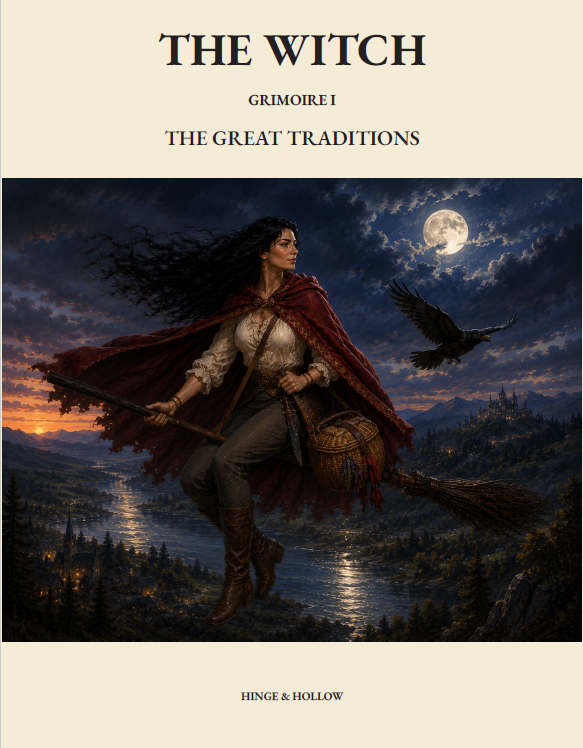
That brings me to The Witch: Grimoire I – The Great Traditions, a supplement for fifth-edition Dungeons & Dragons that introduces a new character class built around traditional witchcraft and folk magic.
I received a review copy of The Witch, and I want to thank the creators for the opportunity to look through their work. Before getting started, I want to make something clear. I haven’t had the opportunity to use this supplement during an actual game. While I played Dungeons & Dragons 5E for many years, I’m not particularly thrilled with the direction the game has taken with 5.5E, and I honestly don’t see myself returning to D&D anytime soon. These days, my gaming interests are focused more on Shadowdark, other old-school renaissance (OSR) games, and independent game systems and developers.
That doesn’t mean I can’t appreciate an interesting supplement for 5E, though. What follows is a review of the material itself, including the rules, character options, and how I think the class might fit into a campaign, rather than a review based on actual gameplay.
I’m always interested in seeing how different designers approach magic in tabletop roleplaying games, particularly when they move beyond the usual fireballs, lightning bolts, and other flashy spells. The Witch certainly takes a different approach, and there are a few things here that I found particularly interesting.
A quick note about the artwork: According to the creator, certain illustrations in The Witch were produced with generative-AI assistance under Hinge & Hollow’s art direction, curation, editing, composition, and production supervision. I know AI artwork can be a controversial subject in the hobby, but personally, I’m not opposed to its use in smaller independent projects. Commissioning artwork can be expensive, especially for someone just starting out, and those costs can sometimes mean the difference between getting a supplement published or not. I do feel differently about larger, established publishers like Wizards of the Coast and Goodman Games. Companies with established budgets and resources should be supporting human artists rather than relying on AI-generated artwork. For me, there’s a difference between an independent creator trying to bring a project to life and a larger publisher looking to reduce production costs.

What Is The Witch?
The Witch: Grimoire I – The Great Traditions introduces a complete Witch character class for fifth-edition Dungeons & Dragons. This is not a standalone roleplaying game, so you’ll need the appropriate fifth-edition rules to make use of it.
The supplement approaches witchcraft through the lens of folklore, emphasizing the traditional practices associated with witches rather than simply creating another spellcaster with a different spell list.
The Witch uses magic, but her abilities extend well beyond conventional spellcasting. She creates charms, ties magical knots, prepares brews, uses powders and salts, reads omens, and works with familiars. There are also systems for disguises, glamours, blessings, curses, and manipulating fortune.
One of the central ideas presented in the book is that casting a spell and working witchcraft are two different things. A Witch may cast spells like other magical characters, but she can also use magical workings that operate under their own rules.
This helps distinguish the class from familiar options such as the Druid or Warlock. Although there is some thematic overlap, The Witch is built around the practice of folk magic rather than simply offering a different source of magical power.

The Witch Character Class
The Witch is presented as a full character class with advancement from 1st through 20th level. She uses a d8 Hit Die, has proficiency with simple weapons, and relies on spellcasting alongside her various witchcraft abilities.
As the character advances, she gains access to increasingly powerful forms of witchcraft. These abilities are organized into different categories, with new tiers becoming available at higher levels.
The class also includes familiars, magical regalia, sympathetic magic, and other abilities that reinforce its folkloric identity.
I particularly like the emphasis on sympathetic magic. The idea that a personal object, a name, or some other connection to a person can be used as part of a magical working fits very well with traditional stories about witches.
It also provides opportunities for roleplaying. Finding the right materials or obtaining a personal possession could become part of an adventure rather than simply being something handled with a spell slot.

The Four Great Traditions
One of the major features of the supplement is the inclusion of four Witch Traditions. A character selects a tradition at 3rd level, gaining additional abilities as she advances.
Rather than simply dividing witches into good and evil categories, these traditions represent different philosophies about the purpose of witchcraft.
The Green Witch
The Green Witch focuses on life, growth, nature, renewal, and the living world. This is probably the tradition most closely associated with the familiar image of the herbalist or wise woman who lives on the edge of a village.
A Green Witch might work with plants, animals, and the natural cycles of the world, making it a natural choice for players interested in that side of folklore.
The Black Witch
The Black Witch focuses on dominion, authority, command, and power. This tradition is concerned with imposing one’s will and controlling circumstances.
It would be easy to assume that the Black Witch is simply the evil option, but the book doesn’t present the traditions as moral alignments. Instead, it treats them as different approaches to the Craft.
I can see this tradition being particularly useful for creating an intimidating or morally complicated character.
The Red Witch
The Red Witch is associated with battle, courage, fear, timing, and the shifting fortunes of combat.
This tradition appears suited to players who want a Witch who takes a more active role in dangerous situations. Rather than simply dealing damage, the Red Witch’s theme emphasizes influencing the course of a battle.
I like that the designers included a tradition focused on conflict without simply turning it into a collection of offensive spells.
The White Witch
The White Witch emphasizes protection, healing, vigilance, and keeping others safe.
This is another tradition that fits naturally with the traditional image of a village wise woman, particularly one who protects her community from supernatural dangers.
It could be an interesting option for someone who enjoys playing a supportive character.
Taken together, these four traditions provide a reasonable variety of character concepts. They also help demonstrate that the Witch isn’t necessarily defined by whether she uses her magic for good or evil, but by what she believes witchcraft should accomplish.

Witchcraft Beyond Spellcasting
For me, the most interesting part of the supplement is the detailed treatment of witchcraft itself.
The book includes several different magical arts, each with its own rules and progression. The four principal Material Arts are Charmcraft, Knotcraft, Brewcraft, and Powders & Salts.
Charms can provide magical effects through prepared objects, while knots allow magic to be bound into cords and similar materials. Brews offer another approach to magical preparation, and powders and salts provide additional methods for working the Craft.
Beyond those material arts, the Witch also gains access to Maskcraft and Glamourcraft, which influence roles and perceptions, and the Eye, which can affect fortune. There are also Signs, allowing the Witch to recognize omens through things such as weather, dreams, animals, or other seemingly ordinary events.
What ties these abilities together is the importance of preparation. The Witch is strongest when she has the knowledge, materials, and opportunity to choose the right working for a situation. That creates an interesting style of play in which gathering information and planning ahead can be just as valuable as casting a spell during an encounter.
I appreciate the attention given to these different methods. They help create the feeling that the Witch is practicing an established tradition rather than simply using a collection of unrelated supernatural powers.
However, this is also where I see one of the potential drawbacks.
There is a lot to keep track of. Players need to understand the difference between spells and witchcraft workings, the requirements for creating and using those workings, and how the various arts advance as the character gains levels.
For someone who enjoys detailed character systems, this could be a major attraction. For a player who prefers a simpler approach to magic, it may be more complicated than they’re looking for.
What About the Game Master?
Whenever a supplement introduces a substantial new character class, the Game Master has to consider how it will fit into the campaign.
The Witch brings several abilities that may require a little more attention than usual. Sympathetic magic, divination, wards, and other workings could influence how characters approach mysteries, social encounters, and adventures.
Fortunately, the supplement includes guidance for Game Masters on challenging Witch characters fairly and incorporating witchcraft into a campaign.
I appreciate that the book encourages Game Masters to challenge the Witch through meaningful choices and consequences rather than simply declaring that her abilities don’t work. Time pressure, unexpected complications, and clever opponents can all create interesting situations without undermining the character’s central abilities.
The book also discusses using Witches as NPCs, which may be useful even if nobody in the party wants to play the class.
I can easily imagine using some of these ideas to create a memorable village wise woman, a mysterious herbalist, or a dangerous witch living deep in the wilderness.
In fact, I think some of the material could provide inspiration for Game Masters running other fantasy roleplaying systems, even if the actual mechanics would need to be adapted.

The Good and the Not-So-Good
After going through the supplement, there are a couple of things that stand out to me.
On the positive side, I really like the way the book establishes a distinct identity for the Witch. The various magical arts draw heavily on folklore, while the four Great Traditions provide different directions for character development without simply dividing them into good and evil options.
On the other hand, the amount of additional material could be intimidating for some players. There are multiple systems to learn, and keeping track of the different workings may slow things down until the player becomes familiar with the rules. I’m also curious about how the class balances against existing fifth-edition options.
Neither concern is something I can properly judge without seeing the class in action. A detailed magical system may be exactly what some players are looking for, while others may find it more involved than they prefer.
Final Thoughts
The Witch: Grimoire I – The Great Traditions is an interesting take on a familiar fantasy character concept, with an emphasis on the folklore and traditions surrounding witchcraft.
The combination of charms, knots, brews, omens, and other magical practices gives the class a distinctive atmosphere and provides plenty of opportunities for roleplaying.
At the same time, this isn’t necessarily a class I would recommend to someone who wants a simple introduction to fifth-edition spellcasting. There are quite a few additional mechanics involved, and I suspect the Witch will appeal most to players who enjoy digging into a detailed character system.
I also think there is some useful inspiration here for Game Masters, even if they don’t plan on allowing the Witch as a player character. The folklore, magical practices, and suggestions for using Witches as NPCs could all provide ideas for adventures and encounters.
Although I’ve moved away from Dungeons & Dragons in favor of Shadowdark and other independent games, I still enjoy seeing what creative designers are bringing to the hobby. There is plenty of interesting material being produced outside the major publishers, and I think it’s important to give those creators some attention.
My impression is that The Witch offers a detailed and distinctive approach to bringing traditional witchcraft into fifth-edition fantasy gaming. Whether all those systems work smoothly together is something I would need to determine through actual play.
I want to thank the creators for providing the review copy and allowing me to look through their work. While I don’t anticipate returning to D&D anytime soon, I appreciate the creativity and effort that went into this supplement.
If you’re still playing fifth-edition Dungeons & Dragons and enjoy folklore-inspired magic and detailed character options, The Witch may be worth a look.
Keep on gaming!
2026 Goals Progress
- Minis Painted: 278/150 – COMPLETED
- Large Models / Terrain: 38/ 6 – COMPLETE
- YouTube Videos: 21/ 24
- Game Reviews: 9 / 4 – COMPLETED
- Games Played (TTRPG + Board Games): 1 / 4
- Thursday Drop-Ins Created: 9/ 12
- New TTRPG Systems Tried: 1 / 3
- Shadowdark Mini-Campaign Sessions: 0 / 3
- Shadowdark Release on DriveThruRPG: 2/1 – COMPLETE
Leave a Reply