
03/19/2026
Happy Thursday, and welcome back to Tabletop Thoughts!
There’s a moment in every game where players stop, look at each other, and realize they have no idea what they’re dealing with. That moment—when the rules aren’t obvious, and the outcome isn’t predictable—is where tabletop RPGs shine. Shadowdark thrives in that space, and Creature Companion is built entirely around creating more of those moments.

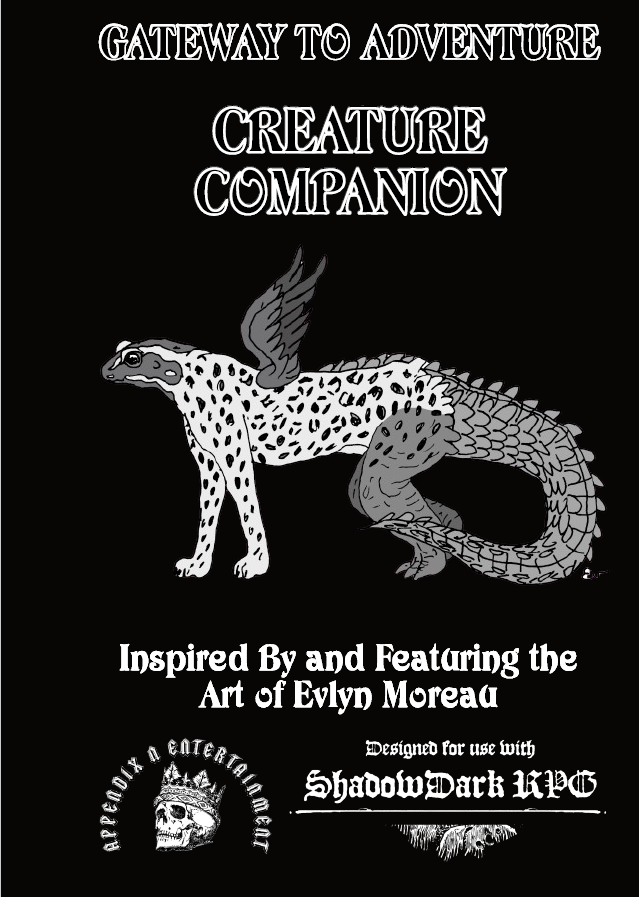
Creature Companion is a third-party Shadowdark bestiary packed with strange, imaginative monsters inspired by the artwork of Evlyn Moreau. Instead of reinventing the system, it expands it in the best possible way—by giving GMs a wealth of new creatures to bring to the table.

Evlyn Moreau
Evlyn Moreau has quietly become one of the defining artists of the modern OSR scene, and it’s not hard to see why. Her work captures something that a lot of fantasy art has lost: a sense of strangeness and discovery.
There’s a looseness to her ink work—creatures feel like they were pulled from half-remembered myths, strange dreams, or the margins of an old bestiary. They’re not overly polished, not hyper-realistic, and that’s exactly the point. They feel alive in the way classic TSR-era art did.
Moreau’s Patreon-driven model is also worth highlighting. By making her work broadly usable for creators, she’s effectively become a wellspring of inspiration for indie RPG design. You can see that influence directly in Creature Companion, where the monsters aren’t just illustrated—they’re born from the art itself.

The Artwork
The art in Creature Companion is doing more than just filling space—it’s doing the heavy lifting of tone and inspiration.
Every creature feels like it started as a visual idea first, and that shows. The designs are:
- Weird without being random
- Simple, but memorable
- Instantly usable at the table
You get things like multi-limbed sheep that sing to the stars, skeletal cats with ghost flames, and impossible insectoid mounts drifting across the astral sea. None of it feels generic.
Importantly, the black-and-white presentation works perfectly for Shadowdark. It keeps the book readable, evocative, and easy to reference during play. There’s no visual clutter—just clean, imaginative designs that spark ideas immediately.
This is the kind of art that makes a GM stop mid-session and think, “I need to use this tonight.”
Creature Companion
This is where the book really shines—and where it stands out in the current Shadowdark ecosystem.
Creature Companion is exactly what more third-party content should be:
a toolbox, not a rewrite.
Instead of trying to reinvent the system, it expands it in the most useful way possible—more monsters.
And not just filler monsters. These are creatures with:
- Clear identities
- Strong hooks
- Mechanics that reinforce their lore

A Great Example: The Lupogriff
Everyone at the table knows what an orc does. A troll regenerates. A goblin ambushes.
But what about a Lupogriff?
Right away, the name sparks curiosity—and when players see it, that curiosity turns into tension.
The Lupogriff feels like a creature pulled from myth but twisted just enough to be unfamiliar. Part wolf, part something more primal and monstrous, it carries that perfect Shadowdark energy: recognizable, but not predictable.
And that’s the key.
Because the moment players don’t recognize a monster, everything changes. They hesitate. They start asking questions. They stop assuming they know how the fight will go.
Is it fast? Does it hunt in packs? Does it have some strange ability they haven’t seen before?
Now the encounter isn’t routine—it’s uncertain.
That’s what something like the Lupogriff brings to the table. It creates a moment where players lean forward instead of falling back on what they already know.
Why This Matters for Shadowdark
This is the part that really clicked for me.
Shadowdark doesn’t need to become something else. It doesn’t need endless new classes, subclasses, or systems bolted onto it.
We don’t need:
- Classes that feel like 5E subclasses in disguise
- Background concepts stretched into a full class chassis
- Mechanical bloat that muddies the core design
What we do need is exactly what this book provides:
- New monsters
- New problems
- New unknowns
Because that’s where tension comes from.
Players know what an orc is. They know how to fight a troll.
But when they encounter something like a Lupogriff?
They don’t know the rules. They don’t know the weaknesses. They don’t even know if fighting it is the right answer.
And that uncertainty is where Shadowdark shines.
Final Thoughts
This is an easy recommendation.
If you’re running Shadowdark and want more than just another reskinned goblin or orc, Creature Companion delivers exactly what you need. It’s imaginative, usable, and full of ideas that can immediately hit the table.
More importantly, it represents the kind of third-party design the game benefits from most:
Expand the world. Don’t rewrite the system.
If more creators follow this path—focusing on monsters, spells, and strange ideas instead of system bloat—we’re going to see Shadowdark stay sharp, focused, and incredibly fun to run.
I backed Creature Companion on Kickstarter, and it’s absolutely delivered on what I was hoping for—more tools to make my Shadowdark games feel strange, tense, and unpredictable. If this sounds like something you’d want at your table, you can grab it now on DriveThruRPG: https://www.drivethrurpg.com/en/product/494432/creature-companion-shadowdark-edition?src=hottest_filtered
Keep on gaming!
2026 Goals Progress
- Minis Painted: 136/ 150
- Large Models / Terrain: 6 / 6 – COMPLETE
- YouTube Videos: 4/ 24
- Game Reviews: 4 / 4 – COMPLETED
- Games Played (TTRPG + Board Games): 0 / 4
- Thursday Drop-Ins Created: 2 / 12
- New TTRPG Systems Tried: 0 / 3
- Shadowdark Mini-Campaign Sessions: 0 / 3
- Shadowdark Release on DriveThruRPG: 1/ 1 – COMPLETE
Leave a Reply