
08/14/2025

Look Before You Steal
Before borrowing content from Basic Fantasy to use in Shadowdark, it’s important to understand the key differences between the two systems. While both are rooted in old-school design principles, they handle mechanics like saving throws and morale in distinct ways. What works well in Basic Fantasy may not translate directly to Shadowdark without adjustments. To keep the game balanced and consistent with Shadowdark’s streamlined, fast-paced style, we need to identify where the systems diverge—and adapt accordingly rather than copying content wholesale.
Basic Fantasy vs. Shadowdark: Character Basics
Both systems share an old-school foundation: characters roll 3d6 in order for ability scores, start with relatively low hit points, and choose from the core four classes—Fighter, Thief, Priest, and Wizard—at the beginning.
Let’s look at a character and see for ourselves. I will take a pre-generated fighter from Basic Fantasy and recreate it as close as I can in Shadowdark.

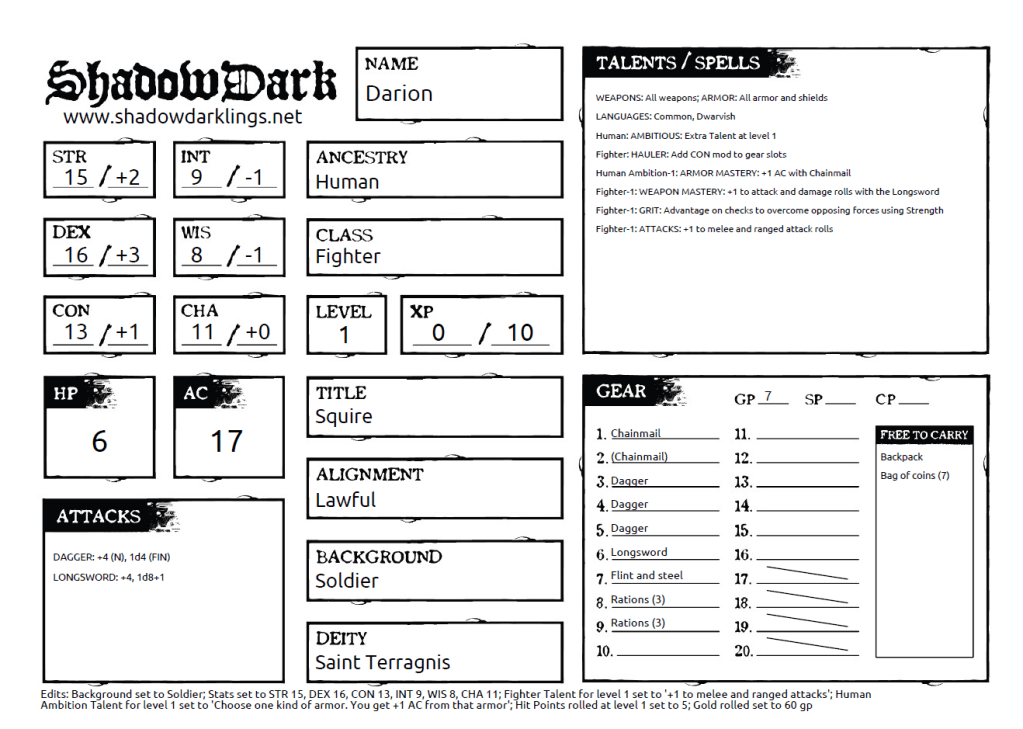
There are some basic differences between the 2 based on the systems that stand out.
Saving Throws
A key mechanical difference comes in saving throws: Basic Fantasy uses five classic categories (Death Ray/Poison, Magic Wands, Paralysis/Turn to Stone, Dragon Breath, and Spells), while Shadowdark streamlines this into ability checks against a DC, tying saves directly to the six ability scores.
Gear Capacity
The amount of gear that a character can carry is different for both systems. Basic Fantasy keeps to the weight system (counting the weight of all gear and comparing it to a chart) while Shadowdark is streamlined with Gear Slots.


What is Morale?
Morale represents a creature’s willingness to keep fighting when things turn grim. Even the most fearsome monsters can lose their nerve when the tide turns against them. A failed morale check might mean retreat, surrender, or hesitation—depending on the situation and the creature’s nature.
When to Check Morale
Roll a morale check at key moments during combat, such as:
- The first monster is killed
- The group is reduced to half strength or fewer
- A leader or champion is slain
- The enemy faces overwhelming odds
- The PCs unleash a fearsome display of power
👉 GM discretion is essential—use these as guidelines, not hard rules.
Morale System Comparison: Shadowdark vs. Basic Fantasy
Shadowdark Morale
- Uses a Wisdom Check with a fixed DC 15.
- If the creature fails the check, it flees.
- Morale is not determined by monster type—all creatures use the same DC, so morale is tied to the individual creature’s WIS modifier, not its nature or role.
- Simple and fast to resolve, but lacks nuance—a goblin and a demon roll against the same DC.
Basic Fantasy Morale
- Each creature has its own morale score, usually between 6 and 12.
- When a morale check is called for, roll 2d6. If the result is greater than the creature’s morale score, it fails the check.
- Provides more granularity and flavor—braver creatures have higher morale, while cowardly ones have lower scores.
- Slightly more complex, but adds depth by making morale monster-specific.
Summary of the Two Systems
- Shadowdark favors speed and simplicity with a universal DC.
- Basic Fantasy offers more detail and differentiation between monster types.
- Choose based on your table’s preference: quick resolution (Shadowdark) or tailored encounters (Basic Fantasy).
Comparing Monster Stat Blocks
Before converting monsters from Basic Fantasy to Shadowdark, it’s worth noting that their stat blocks, while sharing the same old-school DNA, present information differently and emphasize different mechanics. Basic Fantasy follows a B/X-style format, with separate listings for things like armor class, hit dice, movement, and morale, while also using its own saving throw categories. Shadowdark condenses many of these details into a more streamlined, modern layout, often integrating saves as ability checks and omitting certain legacy stats. Understanding how each system organizes and interprets monster data will make conversions smoother, ensuring the creature’s threat level and flavor remain intact.
We will examine some iconic monsters for this demonstration: the goblin, the ogre, and the dragon. All of these monsters are available for free. Basic Fantasy is completely free (www.basicfantasy.org), as are the QuickStart rules for Shadowdark (www.thearcanelibrary.com). This allows anyone with an Internet connection to get the rules to play these games without spending a dime. We will have an overall look, then see the difference in Morale.
Here is a Basic Fantasy Goblin

Here is a Shadowdark Goblin

Overall:
Both goblins have an AC of 11 (14 if they are wearing armor for BF). Hit points will be close. Basic Fantasy is 1 to 7, while Shadowdark is just 5. Damage output is about the same. Overall, they are compatible.
Morale failures for the 2 goblins:
Shadowdark = 75% failure of a DC15 WIS save
Basic Fantasy = 41.67% failure of rolling over a 7 on 2d6
Both systems have the goblins being cowardly, but Shadowdark really pushes it.
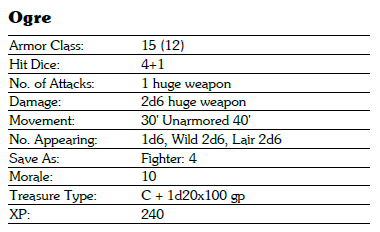
Basic Fantasy Ogre:
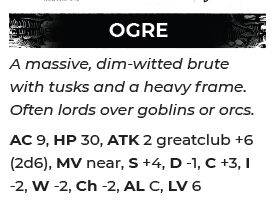
Shadowdark Ogre:
Overall:
There is a HUGE difference in AC between the two systems. Basic Fantasy has the ogre with a 12 AC (15 armored) while Shadowdark has an AC of 9. The hit points are different: Basic Fantasy has a range of 5 to 33 hit points, while Shadowdark just gives them 30 hit points. Shadowdark gives the ogre 2 attacks, while Basic Fantasy is only 1. Both systems have the same damage at 2d6.
Morale failures for the 2 ogres:
Shadowdark = 80% failure of a DC15 WIS save
Basic Fantasy = 8.33% failure of rolling under 10 using 2d6.
These checks are totally different. The Shadowdark ogre is seen as a big, stupid, scared brute, while the basic fantasy ogre is a more aggressive creature that wades into melee combat.
Basic Fantasy Swamp Dragon (Black Dragon):


Shadowdark Swamp Dragon:

Overall:
AC is similar for both, showing that the scales of the dragon act like armor. Hit Points for Basic Fantasy are 7 to 56, and Shadowdark is set at 58 (very similar). Basic Fantasy gives the dragon 4 attacks(bite or breath weapon), while Shadowdark gives it 3 attacks or a breath weapon.
The Basic Fantasy version of a swamp dragon (Black Dragon) feels more like something out of Game of Thrones—a truly fearsome force—while the Shadowdark version leans closer to How to Train Your Dragon in terms of threat level. An adult dragon’s breath weapon should be something players dread, even at higher levels.
In Basic Fantasy, an adult dragon’s breath weapon deals 7d8 damage, averaging 31.5 points, with even a successful save still dealing half damage. In contrast, Shadowdark’s version only deals 2d10 damage (average 11 points), and a successful Constitution save negates all damage.
While the Fire Dragon in the core Shadowdark book is a much more dangerous foe, it’s not included in the Quickstart rules, so we’ll set it aside for this comparison.
Morale Comparison:
- Shadowdark: 55% chance to fail a DC 15 Wisdom save
- Basic Fantasy: 72.22% chance to fail by rolling over 9 on 2d6
At first glance, both seem a bit low for such powerful creatures. But it’s important to remember that dragons are usually solitary creatures. Morale checks typically occur only when they’ve dropped to half health or after a stunning show of force from the party. These are intelligent beings—if they’re seriously wounded or overwhelmed, they’re smart enough to retreat and fight another day.
Conclusion
When it comes to converting material between Basic Fantasy and Shadowdark, the devil is in the details. While both systems spring from the same old-school foundations, their mechanical differences—especially in saving throws, encumbrance, and morale—shape how characters and monsters feel in play. Basic Fantasy thrives on granularity, giving creatures unique morale scores, detailed stat blocks, and a wider range of potential outcomes. Shadowdark trims the fat for speed and ease, relying on streamlined checks and consistent mechanics that keep the game moving quickly.
The goblin, ogre, and dragon comparisons show just how much these differences can influence encounter tone and difficulty. What might be a cautious but capable foe in Basic Fantasy could turn into a panicked or underpowered enemy in Shadowdark without careful adjustment. Adventure ideas and encounter concepts can often be stolen from Basic Fantasy with little or no change, but taking monsters and NPCs over will usually require more work than simply dropping them into your campaign. Before porting content from one to the other, it’s worth considering how these systems express danger, bravery, and survivability—and then adapting accordingly.
Keep on gaming!
 tabletop-thoughts.com
2 thoughts on “How to Adapt Basic Fantasy Content for Shadowdark”