
02/23/2023
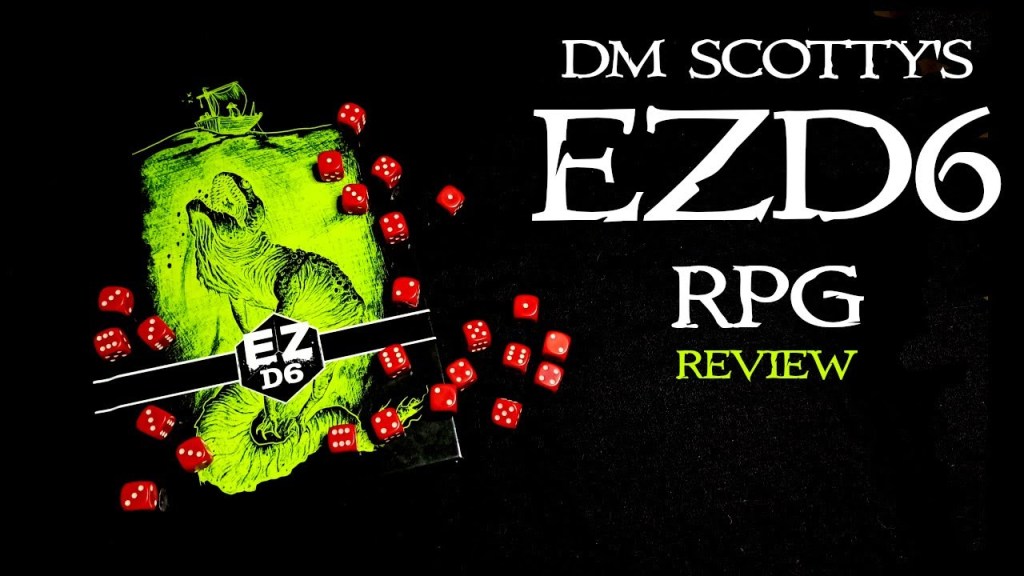
Recently I picked up EZD6 from Amazon since I wanted to see more of the game after watching a few of the YouTube videos from DM Scotty, creator of the game.
The book begins with a couple of pages as an introduction to the game.
How to Play
This huge section (41 pages) describes the game mechanics, hero creation, magic, and combat.
Game Mechanics
The main mechanic of the game is really a simple idea. You roll a D6 when you perform a task and you need to hit a target number determined by the Rabble Rouser (Game Master) or higher to succeed. That’s it! If the task is something that you trained in, you roll a Boon (2D6 and keep the highest number). If something is making the task harder for you, you roll with a Bane (2D6 and keep the lower number). There are some exceptions to this rule but that is the general idea of the game. This is very similar to the Advantage/Disadvantage rule in D&D 5E. I like the simplicity of the mechanic. This would be an easy concept for young gamers to understand and for new players that don’t want to deal with tracking a lot of modifiers to a roll.
Rolling a 1 is always a failure, but that is not as bad as it sounds. In EZD6, you have a pool of points called Karma that you can use to influence the dice rolls. You gain Karma every time you fail a check or test. You start with a set Karma pool and add to it when you fail. Karma can be spent to increase the results of any die roll with a few exceptions (magic and miracles).
Rolling a 6 is always a success and in melee, you can roll again. Karma can be spent to increase the die total up to a 6. In combat, you can keep adding Karma to each roll allowing the hero to do incredible feats. Karma can’t be spent on a 1 or on magic and miracles since magic is unpredictable and chaotic.
There is another mechanic called a Hero Die. This is a D6 that you can use to reroll any die, even a 1. You can only have 1 hero die at a time, but you can replace it with 5 Karma.
The book discusses how to track time and what actions a player can do in a round of combat. The list is very similar to what most players are used to in an RPG. Initiative, like most of the game’s structure, is focused on the players. Unless surprised, the heroes always go first in combat and they can determine the order they go in each round.
Hit Points is a new idea. All characters (except Brutes) have 3 strikes. That’s it. You will have armor or other ways of avoiding strikes, but you don’t get more strikes as you adventure. If you lose strikes, you only get them back through magic or resting (you get 1 strike back from resting a night after a good meal).
All weapons do only 1 strike of damage, unless it is a great weapon or siege weapon then it does 2 strikes. The way to do more damage during your turn is through the Crit rule. For every 6 you roll in combat, you get to roll again. Karma can be added to this roll so there is the potential to do multiple hits in a single turn. If your target falls and you still have hits left, you make move those hits to another target (adjacent target in melee or any target in sight for ranged). This feature gives the heroes the ability to kill multiple low-power creatures in a single turn, something that the players have seen in movies.
Heroes have an armor score that they can roll to avoid taking a strike of damage. Karma can be used to increase the die roll on this too. Enemies and monsters don’t get an armor roll. Saving throws are boiled down to Miraculous Saves.
The Magick system is a lot more freeform and narrative. There are no spell lists to choose from, the player just describes what their character wants to do and the RR determines a difficulty level (1D6 to 6D6). The RR then rolls the resistance then the player gets to decide the casting effort (1D6 to 3D6) and rolls. If the player beats the RR, the spell works. If not, the spell fails. A roll of a 1 from the spellcaster is an automatic failure, but the caster can use spell burn and suffer a strike to make the spell work. You cannot use Karma with spells but you can use hero die.
Heroes that have a devout inclination can all on miracles. Similar to spells, the RR will determine the difficulty (3D6 to 6D6) and the player rolls their die (1D6 to 3D6). Miracles can only be rolled once per scene and since the gods
can be unreliable, no karma may be used. Miracles can not be used to cause damage or harm.
Money and wealth are also tracked differently than most TTRPGs. There are wealth levels that describe how much money the character has. The levels range from pauper to kingly and there are examples of what each level can afford.
We next get to the section on creating a character. There are six steps to generate a character in EZD6:
- Choose a hero path. Warrior, Warden, Delver, Brute, Rascal, Friar, Conjurer, Beastmaster, or Skald.
- Choose a species: Human, Elf, Dwarf, Halfling, or Goblin.
- Choose inclinations (3 for humans, 2 for the other species)
- Create 2 aspects
- If conjurer, choose a circle of sorcery
- Choose equipment.
The book gives one page to each of the hero paths and lists the special abilities of each. Each one feels different from the others and the inclinations and aspects (coming later in the process) allow more customization to the character.
Species add flavor to the character with a few features that affect gameplay.
There are three pages of inclinations that are special features for the characters. These features allow the player to add defining details to the character that makes them unique in the game world.
Aspects are player-generated traits that are single-line descriptions that “describe the hero’s history, physical trait, or mannerisms.” Some of the examples from the book are: “Traveled with a troupe as a contortionist”, “A highly refined sense of smell”, “An eternal optimist”, and “A light sleeper”. These aspects can be used to gain a boon to a roll if the player can make the case to the RR on how this aspect would be a benefit for the roll. There is even a note about generating aspects: “Note-If playing in an open world or one-shot, players are free to make up names of locations. If playing in an established world consult the Rabble Rouser.”
Next up is the Circles of Sorcery. There are nine circles provided in the book: Arcance Bands, Blastmaster, Botanicalist, Elementalist, Illusionist, Necromancer, Seer, Shadoweaver, and Shapeshifter. There is a paragraph for each circle that describes the circle and what conjurers of that circle can do.
The equipment section tells the player to just choose whatever weapon and armor they want within reason. Since all weapons do 1 strike, it really has no effect on the game, it just has to fit your character concept. There are random tables for common gear and specialty gear that I suggest you use when making a character. it is fun to see what you start with.
Rabble Rousing
This small section (12 pages) tells the Rabble Rouser about running a game of EZD6. It describes what makes a good game and what you will need to run the game. Scotty also goes into detail about using miniatures and terrain in the game which fits since he got his start in the community as a terrain-building YouTuber.
The section goes on to discuss getting your friends to play the game and how to use EZD6 to play out a longer campaign since there are no level or experience points in the game. The rewards for the player are magic weapons, story elements like titles and land, etc. I would highly suggest running a one-shot first to let the players get a feel for the game before launching into a longer campaign.
The Rabble Rousing section gives some tips about deciding on a target number and how to handle spells for the players. It also talks about ongoing conditions like fire, poison, and acid. It also describes how to handle monsters and make them unique like leaders and the BBEG.
Monsters
The monster section is divided into two parts: Classic monsters and EZD6 monsters. The classic monsters include creatures like dragons, giants, and zombies. The new EZD6 creatures are unique and very well-designed. Some of them are familiar to creatures the players might have seen in movies like the Sarlakarn (a cousin to the Sarlacc in Star Wars).
Magick Treasures
This huge section includes a lot of random tables about different types of magick treasure like scrolls, weapons, armor, etc. There is plenty of different tables to create unique treasures.
Handy Bits
This section appears to almost be a list of tables that should be printed out and made into a RR screen. It is everything from rules references to random monster tables to making NOCs. These are great, especially for a new RR to keep on hand so they don’t have to flip back through the book looking for them.
Final Thoughts
EZD6 appears to be a great game to run. It is rules light and easy to learn, especially for younger players. I really like the inclinations and aspects part of the game. (They remind me of Fate.) The game seems to let the narrative of the story instead of the rules dominate the flow, allowing players to try to do many different things without the RR saying that there isn’t a rule for that.
It appears to be a great game to play at a convention or as a one-shot to fill in when some of your players miss your regular RPG session. I am not sure how well it would do for a longer campaign, but then again I haven’t tried to do it. I really want to run a game of this, just to see how the rules and gameplay work firsthand.
Overall, EZD6 is an A+ game that you should really buy and try. It is available through DriveThruRPG.com with the pdf being $12.50, the softcover being $22.50, and the hardcover being $25.50.
Keep on gaming!
 tabletop-thoughts.com
One thought on “Product Review: EZD6 by DM Scotty”